Requiem for a Makerspace
I have a predictable way of coping with the losses that I perceive as a loss: I write about them.
My college cats, Vitty then Alla. My old coworker, Maurice. My teacher and substitute mother figure, Valerie. Even in the years when I wasn't writing much, there was a picture-of-the-day and caption for Daniela.
The story that seared itself into my mind as a child was The Velveteen Rabbit. Not even the book, though I did read that first in English and later in Spanish. I watched one of the 1985 cartoon versions more times than I remember. The line between fiction and reality often blurred for me then, fueled by my vivid imagination encountering my beige suburban environment and concluding that reality had to be something more than this. Along the way, I acquired through the vector of The Velveteen Rabbit a firm belief that things that are loved become, in some meaningful way, Real. I still believe that, in a way that transcends rationality.
In my head, this power is not limited to replicas of living things (like rabbits) and their whimsical cousins (kittycorns, anthropomorphic elephants, or any imaginable stuffed animal). In college, in 4th year Russian, I wrote a short story called Сны кровати (A Bed's Dreams), about an extra-long twin dorm bed that becomes Real through many passing generations of students. It can happen to a bed. It can happen to a space.
There's been times I've had to mute this part of my brain. You can't go through a house attic of beloved things that you had wanted to carefully keep for the future, selecting only a tiny subset that you'll take with you to the next stage of your life in an apartment, with your brain believing that things are made Real through loving them. It would tear you apart. All the clothes I sewed for my kids when they were small were the hardest part. Between the making and the wearing, almost all of those were Real. But realistically, I could only keep about one box's worth. The rest were mailed off to friends, or quickly handed with a waterfall of apology, embarrassment, and gratitude to coworkers whose kids were the right age. There were stuffed animals that were Real -- through my own love and yearning and hope and wishing, even ones that were never loved that way by one of the kids themselves. Those I kept.
I think of those stories now, not only because I moved the box of stuffies and old kid clothes to a storage unit last weekend, but because it has been a hard day. Today was the day I ran out of options for continuing to run the Textile Makerspace I started in December 2018, right after I started my current job.
The Textile Makerspace was Real, but to say so is to state the obvious that it didn't start that way. It was a departmental computer lab. No windows. Terrible ventilation, made worse in the summer. It came with a little portable air conditioner that half-heartedly pumped hot air into the hallway, but Facilities had cut the hole for it precisely so that the hot air would blow into the faculty office across the hall. When he was around, which was often, we couldn't run the air conditioner, which in the end we sent off to departmental storage.
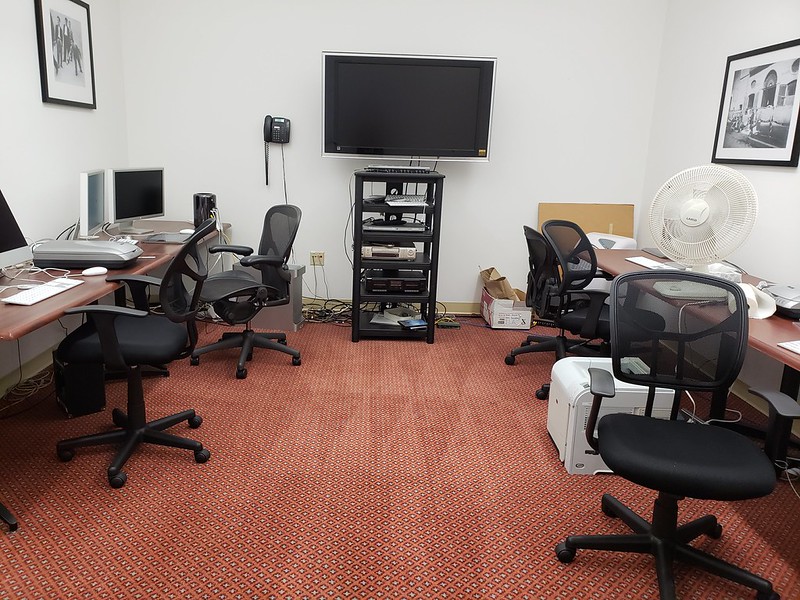
But we blasted fans, cheap little plastic things. And in the pandemic, I used our small amount of funding to buy an air filter and a CO2 monitor and a case of masks. We always made it work.
Before the pandemic the Textile Makerspace got by on volunteers opening the space during lunch a few times a week and maybe in the evening from time to time. But in 2021 as campus was reopening, and then again in 2022 once I wasn't spending all my time archiving Ukrainian cultural heritage websites, the Textile Makerspace got plugged into an emerging network of makerspaces. The wonderful folks from the TAPS Costume Shop helped us get the furniture we needed from campus surplus. There were annual open calls for funding, which got us enough money to hire students to keep the space open regular hours, and in the evenings when students wanted to use it.
That money came with a friendly suggestion that there was more student demand for creative making classes than the available supply. I took the hint and started teaching Data Visualization with Textiles. 2026 was the 4th year running that class, and it's ended up shaping what I do in DH more broadly and how I think about my job.
The story I tell about how the Textile Makerspace became Real in the eyes of the institution is this: that I inherited a departmental computer lab that nobody wanted, so I got rid of the dying computers, bought a couple sewing machines out-of-pocket, printed out a sign that said "Textile Makerspace", and people believed me. And then they started funding it.
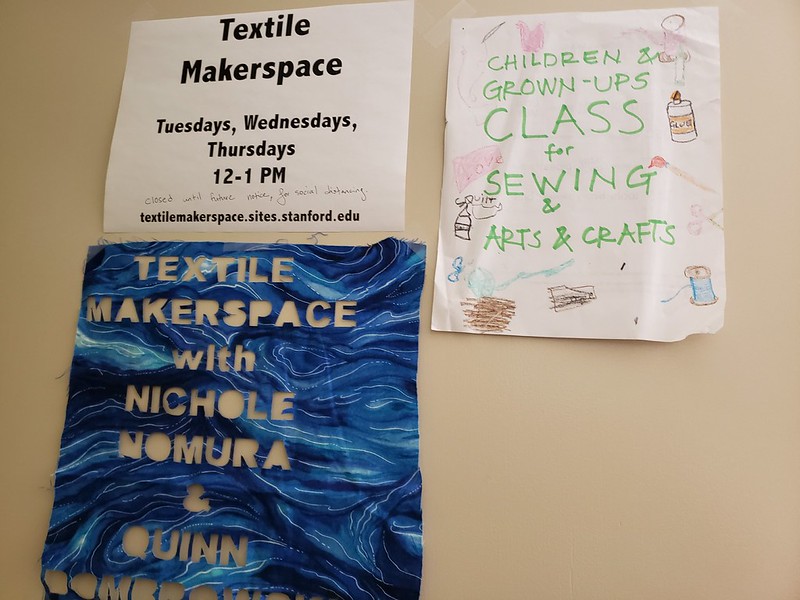
There's some element of the Velveteen Rabbit's nursery magic Fairy to it all. But also more than that: where she transformed beloved worn toys, I found a thing that nobody loved, imagined it to be someplace lovable, and declared it to be so.
And people loved it.
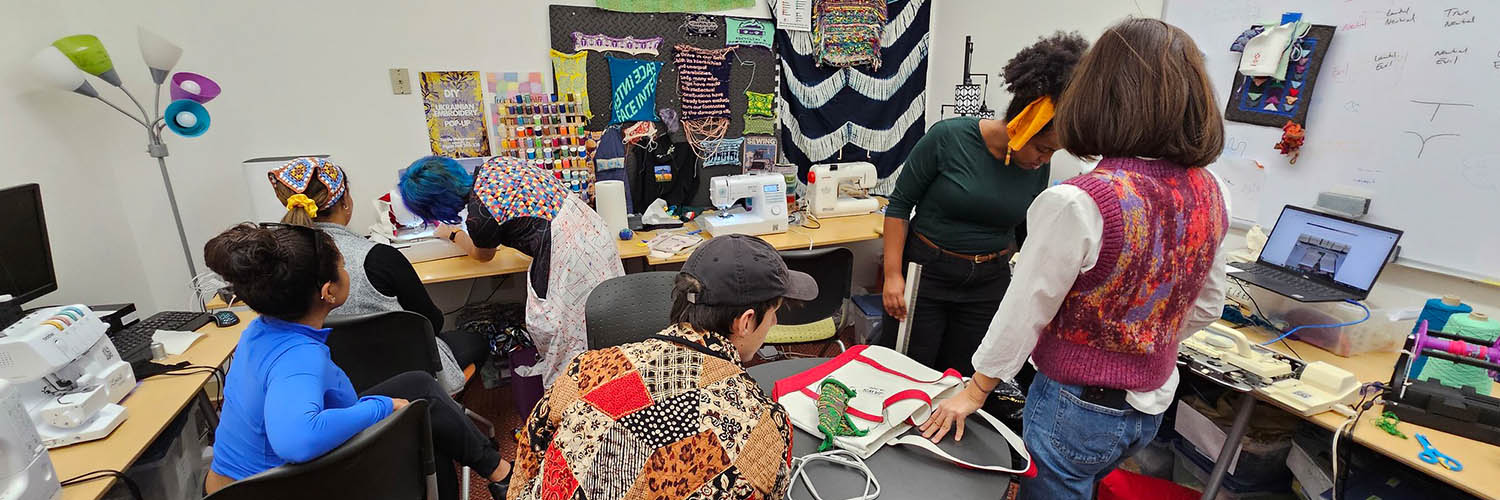
When I'm in my office, in a major hallway with students coming and going from the large lecture room, I work with the door open. Every day, at least one student will stop outside and stare into my office. The giant floor loom where they'd expect a desk. The bookshelf filled with fabric. The embroidery and the yarn and assorted odds and ends.
"What is this place?!" I've been asked more than once. More than five times.
And I grin and say, oh, this is just my office, but if you're into textiles, let me show you the makerspace upstairs, anyone can use it.
It's been described by students, with awe and delight, as the least Stanford place on campus.
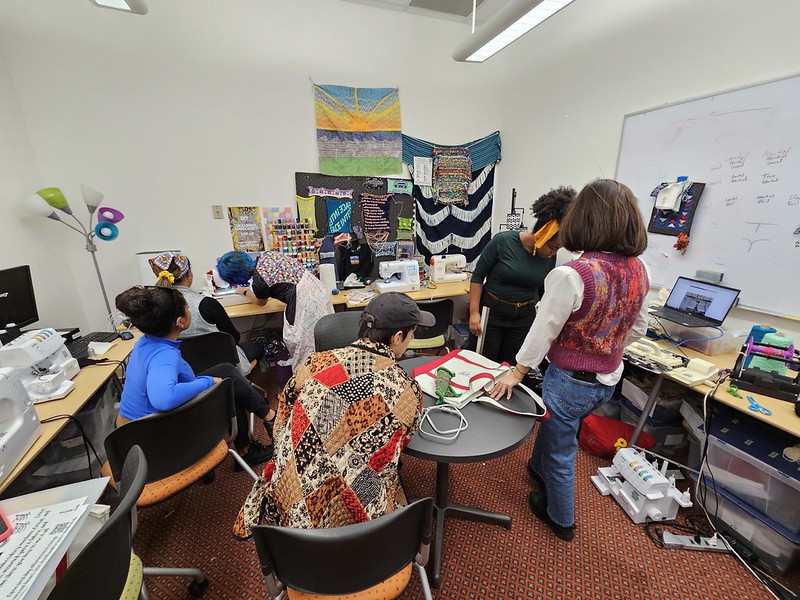
But it needs to be staffed. Part of the whole point of the space is that anyone can wander in and there's a person who can show them how to use the machines and make things. They don't need to be students. They don't need to have to pretend what they want is for a class assignment. They don't need any kind of certification. Anyone can just... make things. Even if they come in knowing nothing at all. At times I've let people have access to the space unsupervised, and at least half the time it ends with broken machines and frustration all around.
You would think that paying students $20/hr to staff a space that brings so much joy and a creative outlet (as well as a venue for various and sundry class sessions, staff retreat activities, and the like) would be easily enough worked out at an educational institution. You would be wrong.
The grant program that used to provide the staffing has been gone for a couple years, and we've made it up to this point stretching out the final (very generous!) grant money. But we're at the bottom of that last bucket, and my optimism that surely something can be worked out has been met with disappointment everywhere. Practically speaking, it makes more sense for the makerspace in Education that we've always collaborated closely with-- which has a brand new space and ongoing funding for undergraduate, graduate, and professional staff -- to expand its already-popular textile offerings and for me to let the Textile Makerspace go.
I had brought my brain around to being on board with that decision before today's meeting that sealed the deal, but had managed to keep it confined to the rationalizing part of my brain until after it was done. Yes, of course, it was the best decision possible under the circumstances, it'll be better for campus anyway, maybe we can even get more sewing machines into circulation. I can spend some time at the other makerspace, or maybe run workshops occasionally, to bring some chaos and whimsy to the metal-and-glass affair.
I get to keep YarnLab, a larger yarn-focused expansion space I opened last year as part of the Digital Humanities center. Nobody else does yarn things and that's where the other makerspaces sends anyone who shows up with those interests. There's a better prognosis for incorporating YarnLab into a broader strategic vision for the center. The Textile Makerspace room itself, on the floor above my office, will serve some purpose in this broader ecosystem -- maybe for fabric storage and cutting, maybe some kind of weaving or knitting machine atelier for people with certification and/or longer-term projects.
My friends at work have been irritatingly sanguine about it, singing the infrastructural praises of YarnLab with its windows, floor space, and air circulation compared to the old space. I don't know how to explain to them that, at least for today, I don't care and that doesn't matter because the thing is, the Textile Makerspace was Real. YarnLab isn't, not yet, not in the same way. I imagine in no small part it's an effort to make me feel better about the situation, but it just makes me sad.
I have about a month until the quarter starts, during which time I have many things to sort out with regard to the space. I dread having to update the website, field the emails, explain that actually, I'm sorry to share this news, but we're not reopening in the fall.
It's made harder by being the third rough day in a row this week. First Dolly Parton, then Tim Curry, and now the first makerspace I started. Yearning to find some joy again in sewing, I stopped by Lacis Museum of Lace and Textiles on the way home, thinking maybe the death of two queer icons who looked amazing in a corset was my sign from the universe to try again on a long-term dream of sewing one myself.
I've gotten to know the folks there through helping them build a modern website. Lacis is for me what I tried to make the Textile Makerpsace for other people. Erin Algeo, the manager, not only knew offhand a good beginner corset pattern, she had a sample out of quilting cotton in the back in exactly my size that she'd sewn ages ago when experimenting with it herself. It was the end of the day, the store was empty, and I couldn't help but laughing as she laced me into it over my t-shirt, giving me a crash course in corsets. To my surprise, it felt like a wearable weighted blanket in the best way. At that point in the day, I couldn't have cared less what anyone else thought or said: I was going to wear this thing to the elementary school back-to-school night.
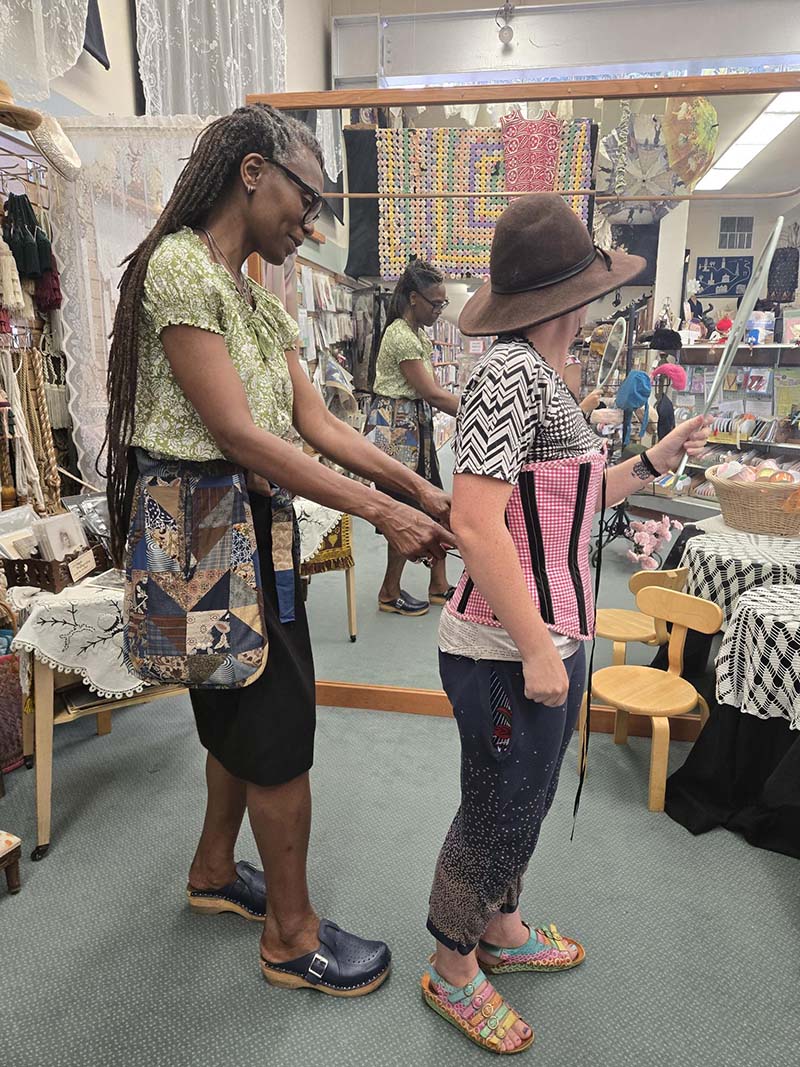
As I sat there in the classroom, with excellent posture in the small-child chair I was seated in (I could not slouch, but did not mind), I thought again about the Textile Makerspace, which was definitely the sort of place where someone could show up and say, "I've always wanted to try making a corset, how do I start?" and receive an encouraging response. Sewing a corset just because was the kind of activity that fit in that space. Is there anything that can be done in the new arrangement to support that same energy? "To make a corset, go to a random corner of the non-English literatures department" feels so much more plausible than "... go to the professional-looking makerspace in the basement of the Education building." I'll be thinking more about this.
For tonight, though, there's not much left besides tears, which start up again so readily as I click through to the ending of that old cartoon where the Nursery Magic Fairy sings her obligatory 80's cartoon song:
"Every ending holds beginnings and the story goes on..."