What do Spinning and the Law Have in Common?
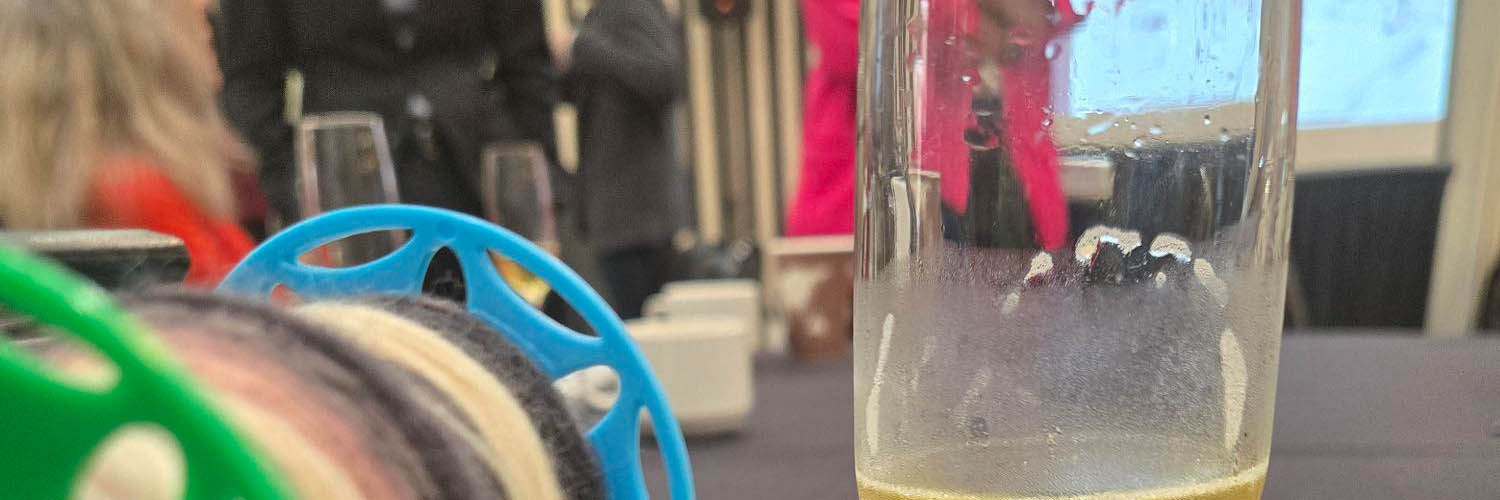
I was invited to speak on the closing panel for the Samuelson Law, Technology & Public Policy Clinic's 25th anniversary. I sat at the front of the room with my tiny Electric Eel Wheel Nano spinning wheel, and finished spinning the roving I'd brought while the other panelist spoke. This is, roughly, what I said about future directions for the clinic -- expanded a bit since we were running short on time by the time I spoke.
I am not a lawyer, but the earlier discussion about the importance of having a good story for your case really resonates with me. I'm from the humanities, and we do narratives.
My background is in Slavic Linguistics and I have a library degree. More importantly, I was an indignant teenager on the internet in 2000 when the copyright extension act and the DMCA were passed. As a result, I became a copyright nerd. Being invited to consult with the Samuelson Clinic around DMCA exemptions felt like being invited to a jam session with my favorite band.
I do some work in the cultural analytics space -- performing computational analysis on in-copyright works through a group called The Data-Sitters Club. I also submitted a comment to the Copyright Office applying those methods to the documents that the Samuelson Clinic filed as a DMCA exemption petition for text and data mining, along with the responses from copyright holders and related organizations. The comment spelled out why we needed to be able to look at decrypted texts with our own eyeballs. I included a data visualization that took the form of a weaving of term frequencies. I used a fluffy yarn to represent AI, since it's a "fuzzy" thing, and you could see it was the copyright holders, not the scholars, talking about it. In fact, there were so many references to generative AI in the response that it made the woven fabric structurally unstable at points.
I have a staff job. I'm not primarily a scholar of researcher or teacher, but I help people with those roles sort out what kind of work they can do and how, within the bounds of what's legal. The challenges of working with in-copyright materials are real, and they're daunting. When the Association for Computers and the Humanities did a survey of our members, the stories we got back were heartbreaking: people shaping their entire careers around 19th century materials instead of works of culture that resonate more for them and their students, all to minimize their entanglement with copyright law.
These people have a very different relationship to the law and lawyers than you do.
You may have noticed that I've spent the last day and a half spinning. That's what the device I have with me is: it's a tiny spinning wheel. When I'm done, I'll spin two or more of these thin wool threads together in the opposite direction to make yarn, and then I can use it to make things, with knitting, crochet, or weaving.
I've noticed you noticing it. Glancing at it quickly before looking away. Maybe watching a little longer out of the corner of your eye. Not saying anything, but I know what you're probably thinking. Maybe you've seen someone knit in a professional space before, but not this. And certainly not while sitting on a panel, in front of the whole room. Is that even allowed? It's definitely weird, and has nothing to do with what we're doing here to celebrate the Samuelson Clinic for Policy and Technology.
And yet, you're all wearing clothes produced by some industrial version of this very same process. Spinning is technology, a very old technology. It happens somewhere else that you don't ever think about, but your unfamiliarity, disinterest, or discomfort with seeing it are immaterial. It's a fundamental part of you having clothes to wear.
This is how the people I work with relate to the law. It makes them uncomfortable. They know it's out there, and if you push them to think about it they might be able to say a few relevant things about it, but they don't understand how it works. Their sense is that the law and lawyers bring nothing good, and an encounter with them may pose an existential threat to their ability to do their research. If they're talking to a lawyer, or discussing legal aspects of their work, their day has almost certainly taken a turn for the worse. By and large, they don't want to be activists. They don't want to take on the DMCA or contractual overrides because the academic system does not reward this. It's better to keep your head down and do your work.
There are always exceptions. Today I've been sitting next to a law professor who connected my spinning to their mom's quilting, sent her a video of it, and we had a great conversation about how exactly weaving works. And there's humanities scholars like David Bamman, who's here with us today, who you can count on to be there for any copyright battle, and who you can put on the stand as a shining example of careful, legally-compliant work.
Most scholars aren't like that, though. They're out there doing their work, squeamishly glancing towards the law from time to time, and hoping that they never have to engage with it because it's weird and uncomfortable and they don't want it in their space.
The advice in a previous panel to "go find people where technology law is causing them problems, and help them" is sound, but how do you overcome scholars' instinctive reaction to avoid lawyers at all costs? My suggestion is this: show up not as lawyers, but as people. Complete people. With lives and families and hobbies and favorite TV shows. Be real people, and find something to connect about -- maybe it's your mom's quilting, or the drama in the Heated Rivalry fandom, or ex-spouses making things difficult. Be curious, be interested, and be the person they know who knows stuff about the law. Get to know people in the communities that are impacted. Go to a Zoom talk about their work. Flip through their latest article. These relationships don't magically happen overnight, but they're worth the effort. When you find yourself working on a brief, looking for the narrative that's going to bring it all together, the pieces you need will be there.
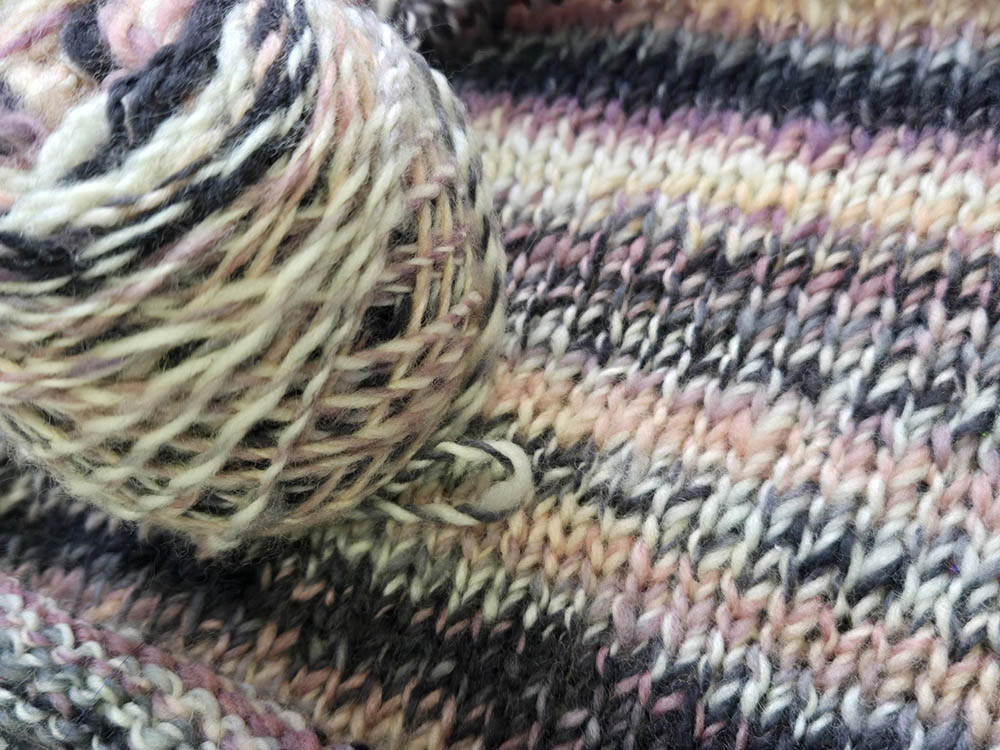
Over the weekend I plied the yarn that I spun at the event, and am knitting a panel for the Clinic out of it, to embroider with the Clinic's logo and 25th anniversary design.